
Disclosure: AI Tools Vetted is reader-supported and may show ads on this page (including Adcash). Meta doesn’t pay us for this article and has no affiliate program with us, so every Meta and provider link here is a plain link. Two sponsored links sit in a separate “Tools we use alongside” box at the end; they are not part of this explainer.
Last updated October 17, 2026 · Specs, license and provider prices checked October 17, 2026 on official pages (USD per 1 million tokens).
TL;DR
TL;DR
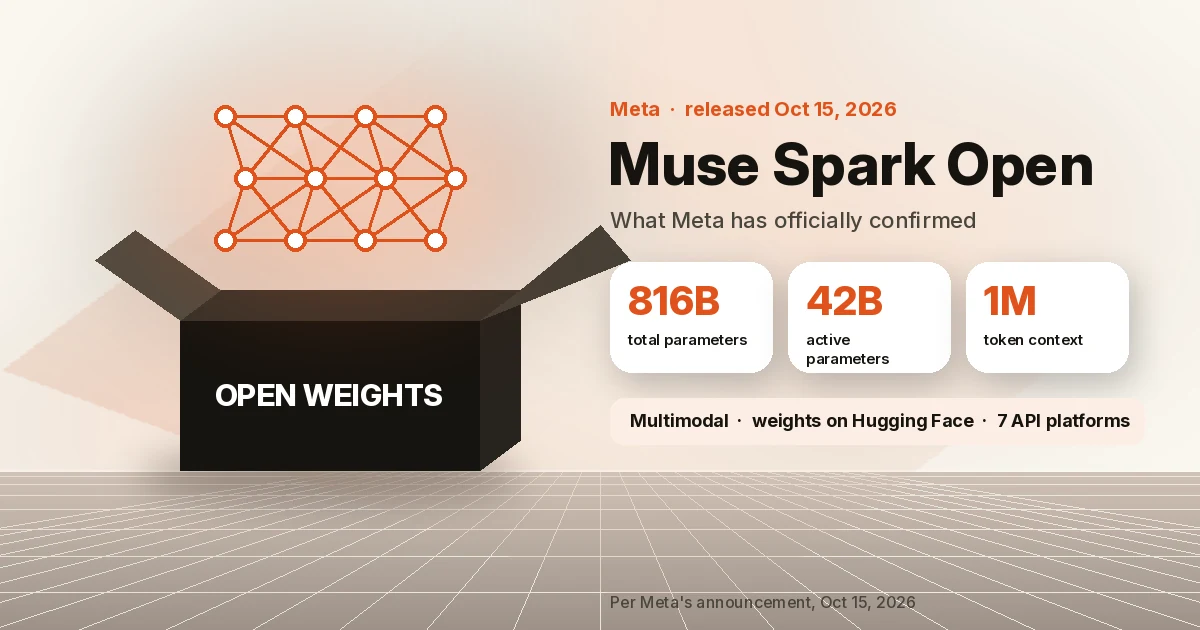
- What it is: Meta released the weights for Muse Spark Open on October 15, 2026. It’s a natively multimodal mixture-of-experts model with 816B total parameters (42B active) and a 1M-token context window.
- Easiest way to try it: a hosted API. Six of the seven API platforms Meta lists publish the same rate (Groq is contact-sales): $1.25 input and $4.25 output per million tokens.
- Running it yourself is a datacenter or multi-Mac job: two M5 Ultra Mac Studios with 512 GB each (or four with 256 GB), or a 4-GPU NVIDIA Blackwell node. No single Mac fits it.
- License: free under the custom Muse Model License, with a “Built with Muse Spark Open” credit and a separate deal for model-as-a-service businesses over $20M revenue.
- We haven’t run it. Benchmarks are Meta’s.
What Muse Spark Open is
Muse Spark Open is “the open-weight release of Muse Spark, Meta’s agentic and coding model,” according to Meta’s developer docs (Muse Spark Open docs). Meta announced it on October 15, 2026, calling it “the most capable US open-weight model to date” and saying it’s “built for coding and agentic work” (Meta AI Research announcement).
The closed Muse Spark models are different products; OpenRouter lists Muse Spark 1.1, 1.2 and 1.3 separately (OpenRouter models API). If a tool says “Muse Spark,” check which one it means.
Specs Meta confirmed
Every figure in this table comes from Meta’s announcement, docs or the official Hugging Face model card (model card), all checked October 17, 2026.
| Spec | What Meta says |
|---|---|
| Release date | October 15, 2026 |
| Parameters | 816B total, 42B active per token |
| Architecture | Mixture-of-experts transformer with a perception encoder; 256 experts, 8 active per token; 62 layers |
| Context window | 1,048,576 tokens (marketed as 1M) |
| Input / output | Text, image, video and audio in; text out |
| Languages | Trained on data from more than 100 languages |
| Checkpoints | BF16 (about 1.65 TB of weights) and NVFP4 (about 537 GB, mostly 4-bit) |
| Reasoning effort | low, medium, high or xhigh; default xhigh |
| License | Muse Model License, plus an acceptable use policy |
| Age | “Not intended for individuals under the age of 18” |
Per Meta’s docs, compute per token tracks the 42B active parameters, but “serving still loads the full 816B weights into VRAM.” The active count makes it faster, not smaller.
Where to use it today
Meta’s announcement names seven API platforms (Baseten, Fireworks AI, Groq, Modal, Nebius, OpenRouter and Together AI) and four places to get the weights (Amazon SageMaker AI, Google Cloud Model Garden, Hugging Face and Microsoft Foundry Models). Here’s what each provider’s own page showed on October 17, 2026.
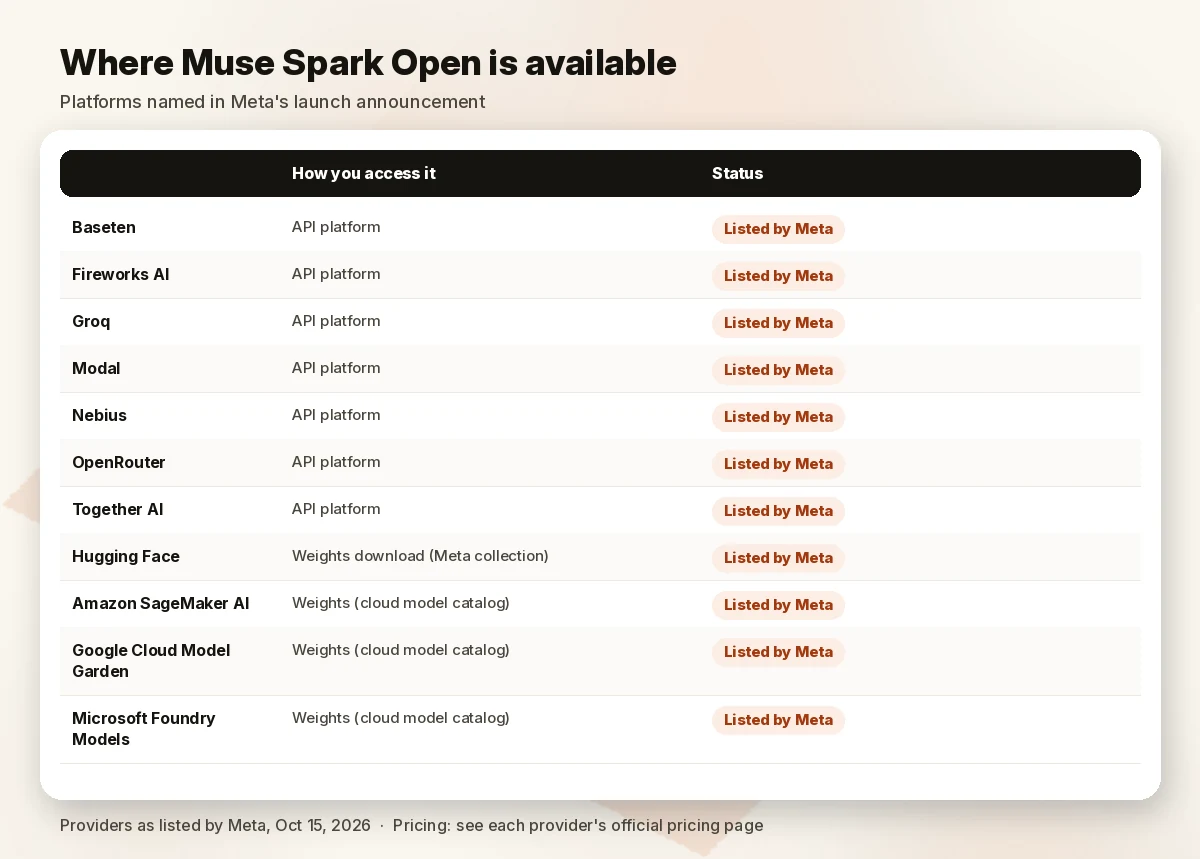
| Provider | Type | Price per 1M tokens (input / cached input / output) | Notes from the provider’s page |
|---|---|---|---|
| Baseten | API | $1.25 / $0.15 / $4.25 | Listed on Baseten’s Model APIs pricing |
| Fireworks AI | API | $1.25 / $0.15 / $4.25 | Serverless is a “limited preview through October 29, 2026,” on US-only capacity, with Fireworks’ usual 50% US-only premium waived |
| Groq | API | Not listed (contact sales) | “Limited preview,” Enterprise only; 131,072-token context window, 350+ tokens/s per user, per Groq’s launch post |
| Modal | API | $1.25 / $0.15 / $4.25 | Shared Endpoint, billed per token |
| Nebius | API | $1.25 / not listed / $4.25 | Token Factory catalog; FP4 checkpoint; region us-north1 |
| OpenRouter | API (gateway) | $1.25 / $0.15 / $4.25 | Routes to Modal, Together, Nebius, Fireworks and Baseten |
| Together AI | API | $1.25 / $0.15 / $4.25 | Listed on Together’s serverless pricing |
| Hugging Face | Weights | Free download | Gated with manual approval: you request access with your full legal name, date of birth and organization, accept the license, and wait for approval |
| Amazon SageMaker AI | Weights (deploy in your AWS account) | You pay for the instance | JumpStart offers BF16 and NVFP4; US East (N. Virginia) and US East (Ohio) at launch |
| Google Cloud Model Garden | Weights | Not checked | Listed by Meta; we didn’t read Google’s page for this model |
| Microsoft Foundry Models | Weights | Not checked | Listed by Meta; we didn’t read Microsoft’s page for this model |
Sources, checked October 17, 2026: Baseten pricing; Fireworks model page; Groq launch post and supported models (Enterprise, contact sales); Modal library page; Nebius Token Factory catalog; OpenRouter endpoints; Together AI pricing; Hugging Face collection; AWS blog.
Limits vary by host. Groq lists a 131,072-token context, and Fireworks and Groq list text and image input only, while Meta and Modal list text, image, video and audio. Check before relying on the full 1M window or video input.
License: what you can and can’t do
The weights ship under the Muse Model License, dated October 15, 2026, which is printed on the Hugging Face model page (model card and license). In plain terms, from the text we read:
- Free of charge. You can use, modify, fine-tune, distill, distribute and sell copies, subject to the conditions.
- Attribution. You must “prominently display ‘Built with Muse Spark Open'” in each product that uses it or a derivative (interface, docs, website or settings).
- Large API businesses need a deal. If you sell model access to third parties and you and your affiliates exceed $20 million gross revenue in any 12 months, you must notify Meta and sign a separate agreement. This doesn’t apply to internal use, research or features of your own product that aren’t a model-as-a-service.
- Outputs. “Meta claims no ownership of outputs generated by the Software.”
- No warranty. It’s provided “as is.”
- Usage policy. An attached policy bans uses such as malware, fraud, spam, fake reviews and presenting outputs as human-written.
Meta itself calls this an “open-weight” release, not open source, and its announcement says the license has “limited commercial terms.” This is our summary, not legal advice. Read the official license before you ship anything.
Benchmarks: only as Meta reports them
Meta’s model card compares Muse Spark Open (xhigh reasoning) with other open-weight models. We haven’t reproduced any of these numbers. A few rows, exactly as Meta reports them:
| Benchmark (Meta’s table) | Muse Spark Open | Highest other score in Meta’s table |
|---|---|---|
| MCP-Atlas | 89.2 | 84.5 (Qwen3.8-2.4T-A95B) |
| JobBench | 61.8 | 61.4 (GLM 5.3) |
| OSWorld Verified | 80.4 | 84.8 (Kimi K3) |
| Terminal-Bench 2.1 (Terminus 2 agent) | 76.4 | 85.0 (Kimi K3) |
| GPQA Diamond | 89.0 | 93.5 (Qwen3.8 and Kimi K3) |
| Artificial Analysis Intelligence Index | 39 | 45 (GLM 5.3) |
Even Meta’s own table is mixed: Muse Spark Open leads some rows, while GLM 5.3, Kimi K3 and Qwen3.8 score higher on others. Meta’s “most capable US open-weight” claim is about US models; we haven’t checked every model’s origin. Meta links an evaluation methodology report and says a “full evaluation report” is “available soon.”
What this changes for you
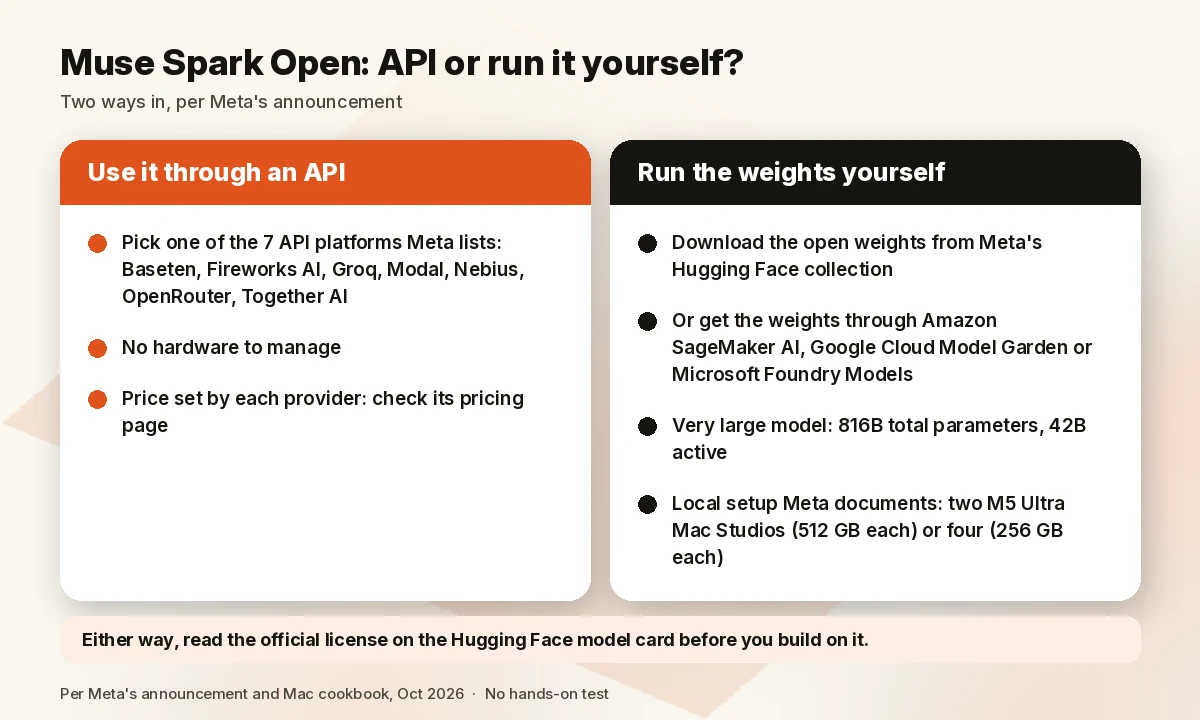
Most people: use an API
For most people, an API is the only realistic option. The six public rates we found were identical, so limits, previews and regions matter more than price. Here’s simple math with the published $1.25 input and $4.25 output rates:
| Workload (our example) | Tokens per request | Cost per request | Per 1,000 requests |
|---|---|---|---|
| Code question with a large file | 50,000 in / 4,000 out | $0.0795 | $79.50 |
| Same prompt, input served from cache ($0.15) | 50,000 cached / 4,000 out | $0.0245 | $24.50 |
| Short chat | 2,000 in / 1,000 out | $0.00675 | $6.75 |
Reasoning effort defaults to xhigh, so expect more output tokens than the visible answer; caching only helps where a cached price is listed (not Nebius).
Teams with GPUs or a cloud budget: self-host for privacy
Self-hosting keeps “every prompt and response inside your infrastructure,” per Meta’s docs, but the hardware bar is high:
- NVIDIA: one 4-GPU Blackwell node (such as B300 or GB300) for NVFP4, or 8 GPUs for BF16
- AMD: 8 × Instinct MI355X or MI350X
- Intel: Xeon 6 with P-cores (such as the 6980P), INT4 checkpoint
The model card adds that you need “at least 700GB of VRAM for NVFP4 and 2TB for BF16” (hardware platforms, model card). That rules out an ordinary VPS or a gaming PC. If you’re on AWS, SageMaker JumpStart deploys it inside your own account.
Mac owners: it’s two or four Mac Studios, not one
“Runs on Macs” was the headline, so here is exactly what Meta’s Mac guide requires (Muse Spark Open on Mac):
- Two Mac Studios with M5 Ultra and 512 GB of unified memory each, or four with 256 GB each. The guide says plainly: “The model doesn’t fit in one Mac’s memory.”
- macOS 26.2 or later and MLX 0.30.1 or later on every Mac
- A direct Thunderbolt 5 link between every pair of Macs
- Enough disk on each Mac for the full NVFP4 checkpoint
- About four hours to set up, per Meta
Apple’s machine learning team reports that “on a cluster of four Mac Studios, Muse Spark Open generates over 36 tokens per second” (Apple Machine Learning Research, October 15, 2026). That’s at an 8,192-token context; two Macs measured 15.7 to 25.0 tokens per second, and Meta’s guide says \”Four Macs serve fastest.\” That’s Apple’s measurement, not ours.
If you mostly want a cheaper model for short API calls, our Claude Haiku 5.5 review covers a much smaller option.
Unknowns and what Meta hasn’t announced
- A consumer app. Meta’s announcement lists API platforms and weight downloads only; it doesn’t mention Muse Spark Open in a consumer app. The closed Muse Spark models are separate models.
- Independent benchmarks. Only Meta’s numbers exist. Meta has published an evaluation methodology report; the full safety evaluation report is “available soon.”
- Groq pricing, and pricing after the previews. Groq is contact-sales only; Fireworks’ serverless preview runs through October 29, 2026.
- Google Cloud and Microsoft Foundry details. We didn’t verify regions or prices on their own pages.
- A single-Mac option. None, per Meta’s guide. We don’t quote Mac Studio prices; check Apple’s store.
Pros and cons
Pros
– Open weights, 1M-token context, text/image/video/audio input (varies by host)
– Free license for most uses; Meta claims no ownership of outputs
– Many hosts at launch, at the same public rate
– Documented recipes for Apple, NVIDIA, AMD and Intel
Cons
– About 537 GB of weights even at 4-bit
– Custom license with attribution and a revenue clause
– Mixed results in Meta’s own table; no independent results
– Previews and context caps vary by host
How we evaluated
We read Meta’s announcement, developer docs and Mac guide, the Hugging Face model card and license, and each provider’s own page, all on October 17, 2026. Benchmarks are Meta’s, the tokens-per-second figure is Apple’s, and the cost examples are our arithmetic from published rates. We didn’t run the model.
FAQ
Is Muse Spark Open free? The weights are free to download under the Muse Model License, which allows commercial use with conditions. Hosted APIs charge per token, typically $1.25 input and $4.25 output per million.
Can I run Muse Spark Open locally? Only on very large hardware: two M5 Ultra Mac Studios with 512 GB each (or four with 256 GB) linked over Thunderbolt 5, or a 4-GPU NVIDIA Blackwell node for the 4-bit version.
Where can I download Muse Spark Open? From Meta’s Hugging Face collection after accepting the license. Meta also lists Amazon SageMaker AI, Google Cloud Model Garden and Microsoft Foundry Models.
How big is Muse Spark Open? 816B total parameters with 42B active per token. The BF16 weights are about 1.65 TB and the NVFP4 weights about 537 GB, per Meta’s docs.
Is it open source or open weights? Open weights, in Meta’s words, under Meta’s own license with conditions, not a standard open-source license.
Sources (official pages, checked on October 17, 2026, ~15:00 BRT)
- Meta announcement (Oct 15, 2026): https://research.meta.ai/blog/muse-spark-open
- Meta docs: https://dev.meta.ai/docs/muse-spark-open
- Meta hardware platforms: https://dev.meta.ai/docs/muse-spark-open/hardware-platforms
- Meta Mac guide: https://dev.meta.ai/docs/cookbook/muse-spark-open-mac
- Model card and license: https://huggingface.co/meta-models/Muse-Spark-Open-816B-A42B
- Hugging Face collection: https://huggingface.co/collections/meta-models/muse-spark-open
- Apple ML Research (Oct 15, 2026): https://machinelearning.apple.com/research/mlx-distributed-inference
- Provider pages: https://www.baseten.co/pricing/ · https://fireworks.ai/models/fireworks/muse-spark-open · https://groq.com/blog/meta-s-muse-spark-open-release-is-now-in-limited-preview-on-groqcloud (Oct 15, 2026) · https://console.groq.com/docs/models · https://modal.com/library/meta/muse-spark-open · https://tokenfactory.nebius.com/model-catalog.md · https://openrouter.ai/api/v1/models/meta/muse-spark-open/endpoints · https://www.together.ai/pricing
- AWS blog: https://aws.amazon.com/blogs/machine-learning/metas-muse-spark-open-now-available-in-amazon-sagemaker-jumpstart/
- TechCrunch, Oct 15, 2026 (press, not used for specs): https://techcrunch.com/2026/10/15/meta-launches-an-open-weight-model-that-runs-on-macs/
Tools we use alongside (outside this explainer; not related to Meta)
If you write about AI models for search traffic, Semrush is the keyword and competitor research suite we use. For the website or small app that calls a hosted Muse Spark Open API, Hostinger offers web hosting. It’s for the site, not the model: an 816B model won’t run on a typical VPS. Both links are sponsored; the Meta and provider links above are not.