
Disclosure: AI Tools Vetted is reader-supported and may show ads on this page. Anthropic has no affiliate program with us, so every Anthropic link here is a plain link and earns us nothing.
Last updated October 10, 2026 · Prices checked October 10, 2026 on Anthropic’s official pricing page (USD).
What’s new in Claude Haiku 5.5
TL;DR
- Released: October 7, 2026, model ID
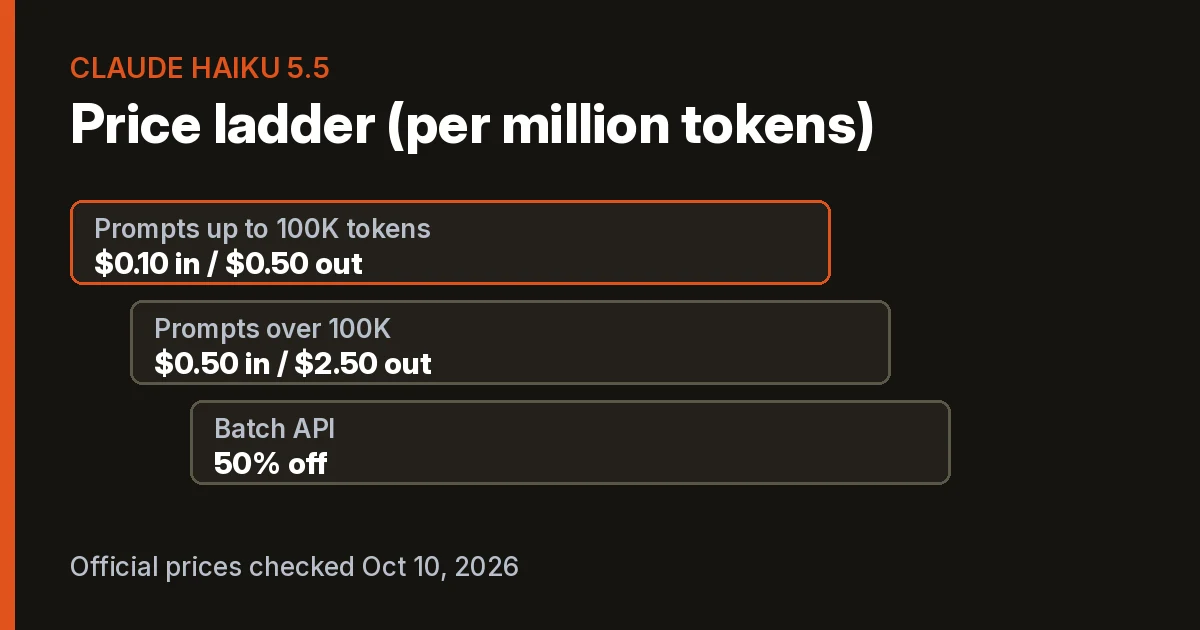
claude-haiku-5-5(Anthropic announcement). - Price: $0.10 per million input tokens and $0.50 per million output tokens for prompts up to 100,000 tokens; five times that above 100K.
- Specs: 1M-token context window, 128K max output, adaptive thinking with an effort setting, text and image input.
- Catch: code written for Haiku 4.5 can break, and the new tokenizer counts about 30% more tokens for the same text.
Anthropic calls Haiku 5.5 “the cheapest, fastest, and most capable small model we’ve ever released,” aimed at high-volume, cost-sensitive work such as summaries, classification, database queries and subagent tasks (announcement). It’s also the first Haiku-class model with an adjustable effort setting, so you can trade cost for quality per request. The same day, Anthropic cut Sonnet 5.5’s cache-read price from $0.20 to $0.10 per million tokens (release notes).
Pricing explained: the 100K-token tier
Haiku 5.5 is priced by prompt length. A request whose prompt is over 100,000 tokens pays the higher rates for the whole request, and cache reads and writes count toward that length (pricing).
| Price per million tokens | Haiku 5.5, prompt ≤100K | Haiku 5.5, prompt >100K | Haiku 4.5 | Sonnet 5.5 |
|---|---|---|---|---|
| Input | $0.10 | $0.50 | $1.00 | $2.00 |
| Output | $0.50 | $2.50 | $5.00 | $10.00 |
| 5-minute cache write | $0.125 | $0.625 | $1.25 | $2.50 |
| 1-hour cache write | $0.20 | $1.00 | $2.00 | $4.00 |
| Cache read | $0.01 | $0.05 | $0.10 | $0.10 |
| Batch API (input / output) | $0.05 / $0.25 | $0.25 / $1.25 | $0.50 / $2.50 | $1.00 / $5.00 |
Source: Anthropic pricing, checked October 10, 2026. US-only inference (inference_geo: "us") adds a 1.1x multiplier, including on the over-100K rates.
Anthropic says prompts up to 100K tokens made up around 90% of requests to Haiku 4.5, and that on average Haiku 5.5 costs around 75% less to run than Haiku 4.5, a figure that already accounts for the new tokenizer (announcement).
Specs (official only)
| Spec | Claude Haiku 5.5 |
|---|---|
| Model ID | claude-haiku-5-5 (Bedrock: anthropic.claude-haiku-5-5) |
| Context window | 1M tokens |
| Max output | 128K tokens (300K on the Batch API with a beta header) |
| Thinking | Adaptive, on by default; default effort medium |
| Input → output | Text and images → text |
| Knowledge cutoff | June 2026 |
| Platforms | Claude API, Amazon Bedrock, Google Cloud, Microsoft Foundry, Claude Platform on AWS |
| Retirement | Not sooner than October 7, 2027 |
Source: Haiku 5.5 model overview, checked October 10, 2026.
Benchmarks: what Anthropic reports
These are Anthropic’s numbers, from its own evaluations on the launch page, including the GPT-6 Luna column that Anthropic itself published. We haven’t run these benchmarks, and no independent results are cited here.
| Benchmark (as reported by Anthropic) | Haiku 5.5 | Haiku 4.5 | GPT-6 Luna | Sonnet 5.5 |
|---|---|---|---|---|
| GDPval-AA v2.1 (knowledge work) | 1620 | 735 | 1437 | 1840 |
| OSWorld 2.1, offline subset (computer use) | 72.4% | 15.7% | 48.9% | 83.9% |
| Humanity’s Last Exam, no tools | 45.9% | 10.2% | not reported | 56.9% |
| Terminal-Bench 4.0 (agentic coding) | 39.2% | 0.0% | 16.4% | 70.6% |
| Chartography, no tools (visual reasoning) | 46.4% | 6.4% | 29.1% | 61.6% |
Source: Anthropic, Claude Haiku 5.5, checked October 10, 2026. Anthropic points to the Haiku 5.5 System Card for methodology.
The pattern matters more than any single score. Haiku 5.5 closes much of the gap to Sonnet 5.5 on knowledge work and computer use, but Sonnet stays far ahead on agentic coding (70.6% vs 39.2% on Terminal-Bench 4.0). Anthropic says so directly: Sonnet 5.5 and Opus 5.5 “remain better choices for complex agentic coding tasks.”
What this changes for you
The headline price is easy to quote. What actually decides your bill is token count, thinking tokens and which side of 100K your prompts land on. The math below is ours, using only the official prices above.
Example 1: a high-volume classifier
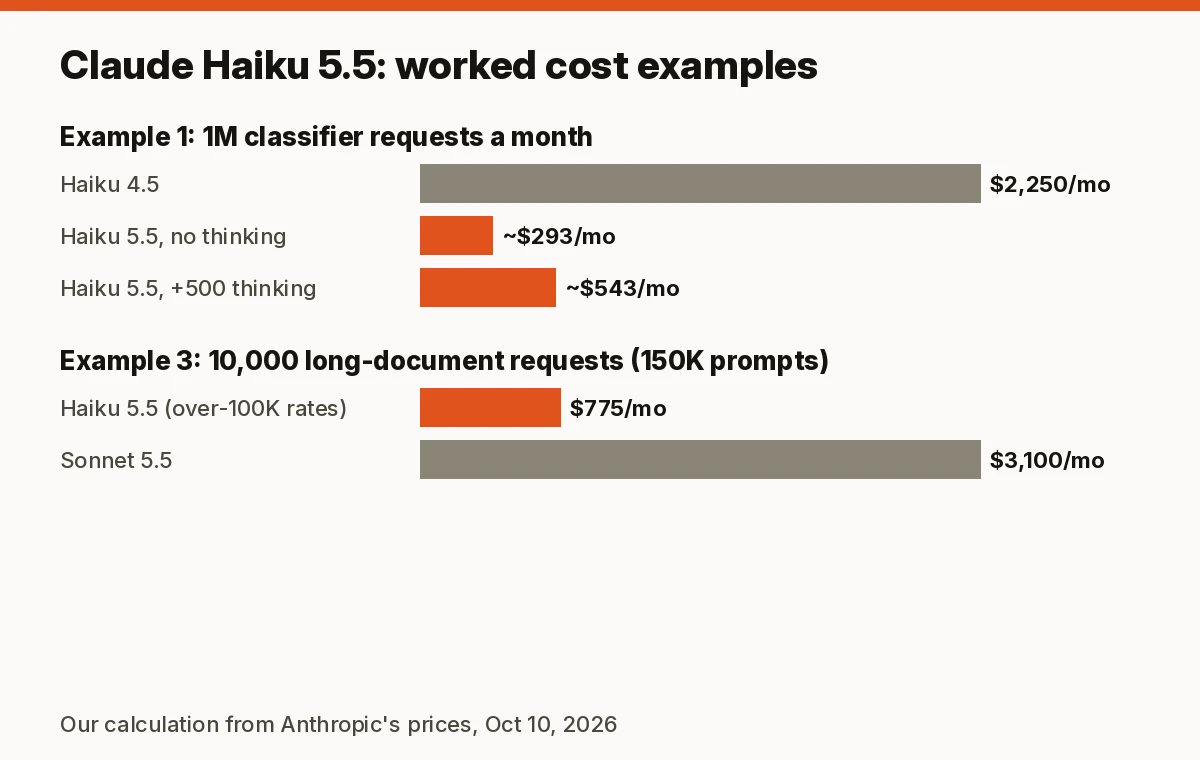
Say you run 1 million requests a month on Haiku 4.5, each with 1,500 input tokens and 150 output tokens.
- Haiku 4.5: 1,500M input tokens × $1 = $1,500, plus 150M output tokens × $5 = $750. Total: $2,250 a month.
- Haiku 5.5, same text: the new tokenizer counts about 30% more tokens (model overview), so roughly 1,950 input and 195 output tokens per request. That’s 1,950M × $0.10 = $195, plus 195M × $0.50 = $97.50. Total: about $293 a month, roughly 87% less.
- The thinking caveat: adaptive thinking is on by default, and thinking is billed as output. If thinking added 500 output tokens per request, that’s another 500M × $0.50 = $250, for about $543 a month. Still far cheaper than Haiku 4.5, but almost double the no-thinking figure. For simple classification, test a lower effort setting and check
usage.output_tokens_details.thinking_tokensin the responses.
Example 2: the 100K cliff
A prompt of 99,000 tokens costs 0.099M × $0.10 = about $0.0099 in input. A prompt of 101,000 tokens costs 0.101M × $0.50 = about $0.0505. Two thousand extra tokens make the request roughly five times more expensive, and output jumps from $0.50 to $2.50 per million too. If your RAG pipeline or agent loop hovers near 100K, trimming retrieved chunks or compacting history can matter more than any other optimization. Remember that cached tokens count toward the threshold.
Example 3: long documents, Haiku vs Sonnet
Take 10,000 requests a month with 150,000-token prompts and 1,000-token answers.
- Haiku 5.5 (over-100K rates): 1,500M × $0.50 = $750, plus 10M × $2.50 = $25. Total: $775.
- Sonnet 5.5 (flat pricing): 1,500M × $2 = $3,000, plus 10M × $10 = $100. Total: $3,100.
Even on its expensive tier, Haiku 5.5 is about a quarter of Sonnet’s cost here. The question is whether its answers are good enough for your documents, and only your own evals can tell you that. If the job isn’t urgent, the Batch API halves either figure.
Who should switch from Haiku 4.5
- Switch soon: high-volume summarization, extraction, routing, classification and support bots with short prompts. The price drop is large even after the tokenizer and some thinking overhead.
- Switch after testing: anything with prompts near or above 100K tokens, and workloads where output length is hard to control.
- Stay on (or move to) Sonnet 5.5: complex, multi-step agentic coding, where Anthropic’s own numbers put Sonnet well ahead.
Migration from Haiku 4.5 in five checks
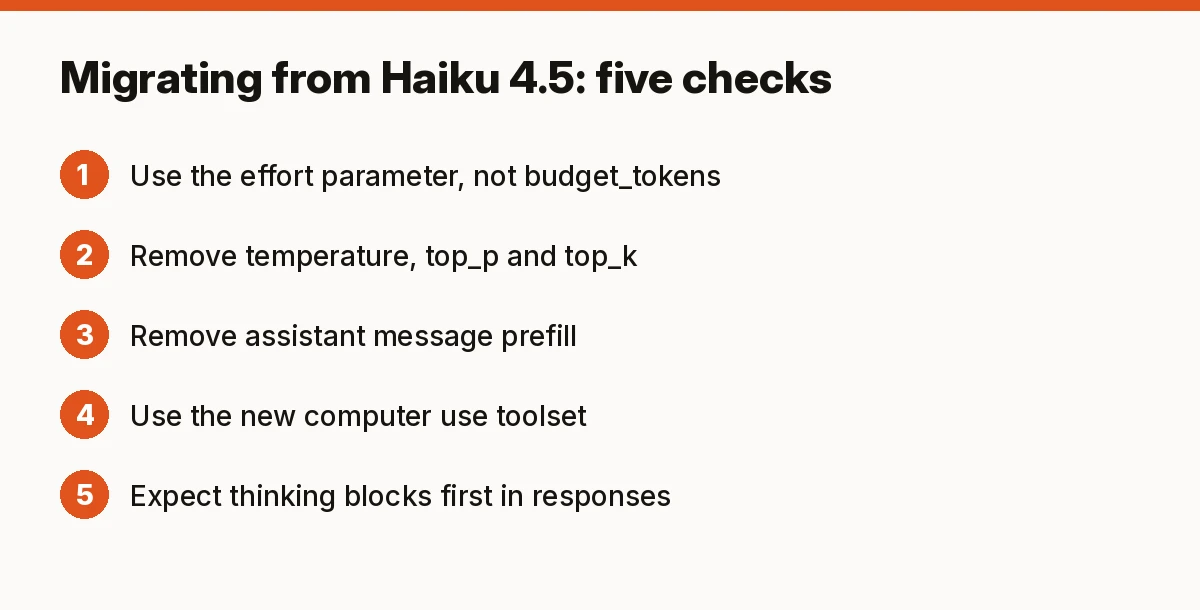
Anthropic’s release notes list what can return a 400 error on Haiku 5.5 (release notes):
- Remove manual extended thinking (
budget_tokens); use the effort parameter instead. - Remove
temperature,top_pandtop_k. - Remove assistant message prefill.
- Replace
computer_20250124withcomputer_toolset_20260801(Claude API and Google Cloud) orcomputer_20251124(Bedrock). - Expect responses to start with
thinkingblocks, and don’t resend thinking blocks after changingsystem,toolsor earlier turns. On Bedrock, structured outputs aren’t available for Haiku 5.5.
Who it’s for, and who should skip it
Good fit: teams paying real money for small-model API calls, apps that need fast responses (Anthropic calls it its fastest model at standard speed), subagents under a larger Sonnet or Opus lead, and image-plus-text extraction jobs.
Skip or wait: if most of your prompts exceed 100K tokens and you can’t trim them, if you need sampling controls like temperature, or if your main workload is hard agentic coding.
There’s also a credit worth knowing about: Anthropic is adding monthly API credits for Claude Max ($100 on Max 5x, $200 on Max 20x) and Team plans (up to $500 pooled), usable on any model (announcement).
Limitations
- The over-100K tier costs five times more per token, for both input and output.
- Breaking changes from Haiku 4.5 (see the checks above).
- More tokens per text: about 30% more than Haiku 4.5, so per-token prices overstate the savings.
- No independent benchmarks yet in this review; every score above is Anthropic’s.
How we review
We built this review from Anthropic’s official pages only, all checked on October 10, 2026: the launch announcement, the API pricing page, the release notes and the Haiku 5.5 model documentation. The cost examples are our own arithmetic on those published prices, with the token assumptions stated. We haven’t run Haiku 5.5 ourselves, so we make no claims about output quality or speed beyond what Anthropic reports.
FAQ
How much does Claude Haiku 5.5 cost? $0.10 per million input tokens and $0.50 per million output tokens for prompts up to 100,000 tokens, and $0.50 / $2.50 above that. The Batch API is 50% off.
What is Claude Haiku 5.5’s context window? 1 million tokens, with up to 128,000 output tokens per request.
Is Claude Haiku 5.5 available in the Claude apps for free? We couldn’t confirm plan-level availability in the Claude apps on an official page, so we’re not answering yes or no. The announcement and pricing covered here are for the API and cloud platforms.
Haiku 5.5 vs Sonnet 5.5: which should I use? Haiku 5.5 for high-volume, narrowly scoped work where cost and speed matter most. Sonnet 5.5 for complex agentic coding, where Anthropic’s own benchmarks put it well ahead.
Will my Haiku 4.5 code work on Haiku 5.5? Not always. Sampling parameters, manual thinking budgets, prefill and the older computer use tool can return errors.
Verdict
For most high-volume, short-prompt workloads, Claude Haiku 5.5 is a straightforward upgrade: on Anthropic’s published prices it’s roughly an order of magnitude cheaper per token than Haiku 4.5, and still much cheaper after the tokenizer change and some thinking overhead. Budget carefully around the 100K-token line, control effort on simple tasks, and keep Sonnet 5.5 for hard coding agents.
Sources (official pages, checked on October 10, 2026)
- Anthropic, Introducing Claude Haiku 5.5 (Oct 7, 2026): anthropic.com/claude-haiku-5-5
- Claude API pricing: platform.claude.com/docs/en/about-claude/pricing
- Claude Platform release notes (Oct 7, 2026 entry): platform.claude.com/docs/en/release-notes/overview
- Claude Haiku 5.5 model overview: platform.claude.com/docs/en/models/haiku-5-5/overview