
Disclosure: AI Tools Vetted is reader-supported and may show ads on this page (including Adcash). Neither Anthropic nor OpenAI has an affiliate program with us, so every Anthropic and OpenAI link here is a plain link and earns us nothing. Sponsored add-on links sit in a separate box at the end and are not part of this comparison.
Last updated October 17, 2026 · Prices checked October 17, 2026 on Anthropic’s and OpenAI’s official pricing and model pages (USD, standard API list prices; app plans are not covered).
The verdict, by scenario
TL;DR
- Prompts up to 100K tokens: a dead heat on list price. Both charge $0.10 per million input tokens, $0.01 for cached input and $0.50 for output (Anthropic pricing; GPT-6 Luna model page). Pick on quality, latency and the API you already run.
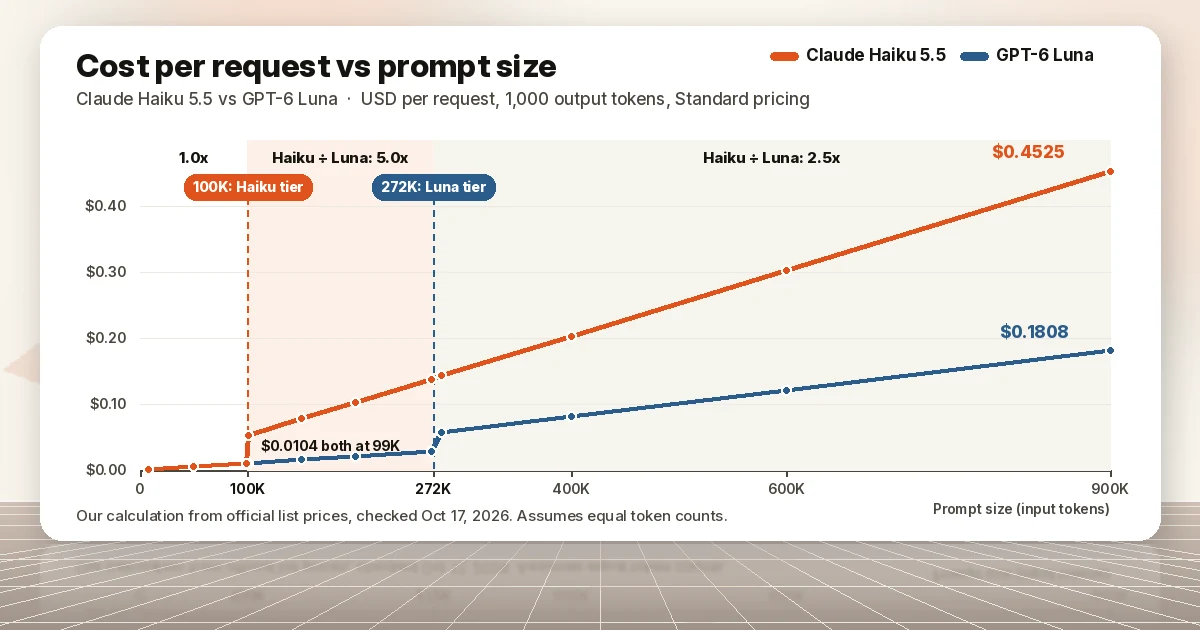
- Prompts between 100K and 272K tokens: GPT-6 Luna keeps its short-context rates while Claude Haiku 5.5 moves to $0.50 in / $2.50 out. On our math, Haiku costs 5x more per request in this band.
- Prompts over 272K tokens: Luna’s rates rise to $0.20 in / $0.75 out. Haiku still costs about 2.5x more per request in our 1,000-token-output examples.
- Benchmarks: Anthropic reports Haiku 5.5 ahead of GPT-6 Luna on every benchmark where it published both. That is vendor data, not an independent test.
Anthropic released Claude Haiku 5.5 on October 7, 2026, and its launch table compares it against OpenAI’s GPT-6 Luna, OpenAI’s “most efficient model for focused, high-volume tasks.” The headline prices match to the cent. This article shows where they stop matching, using only the two vendors’ own pages, and works through three real workloads with the arithmetic laid out so you can redo it with your own numbers. For the full Haiku 5.5 rundown (migration from Haiku 4.5, effort settings), see our Claude Haiku 5.5 review.
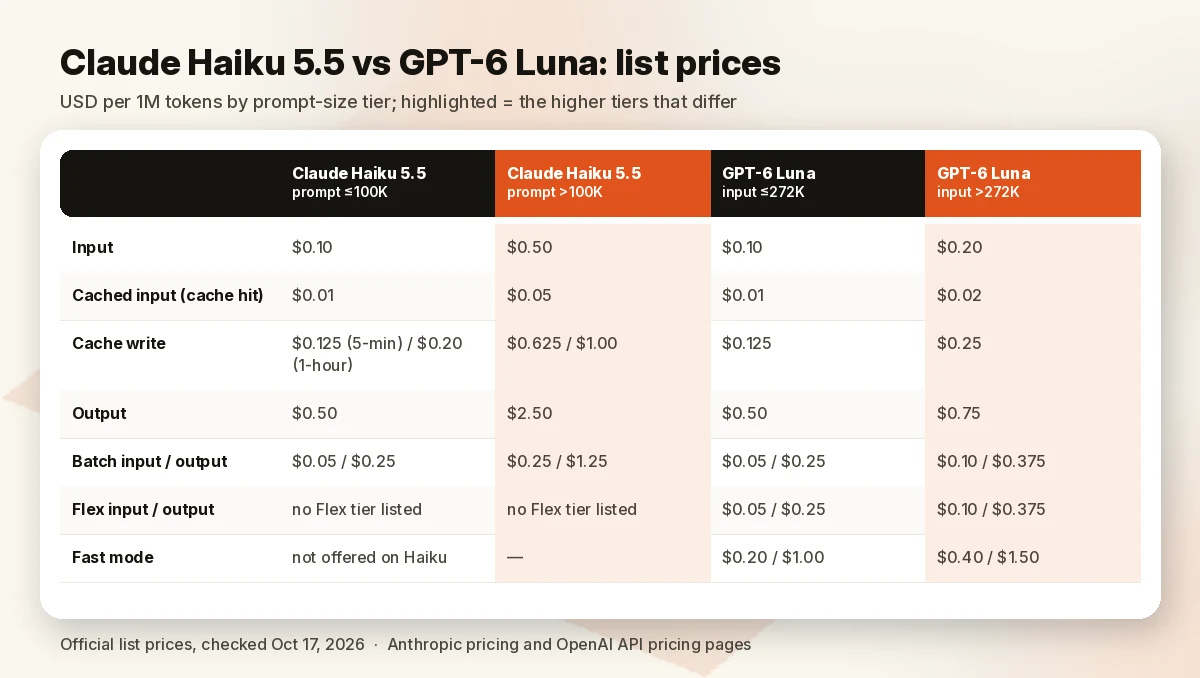
Pricing side by side
| Price per 1M tokens (USD) | Claude Haiku 5.5, prompt ≤100K | Claude Haiku 5.5, prompt >100K | GPT-6 Luna, input ≤272K | GPT-6 Luna, input >272K |
|---|---|---|---|---|
| Input | $0.10 | $0.50 | $0.10 | $0.20 |
| Cached input (cache hit) | $0.01 | $0.05 | $0.01 | $0.02 |
| Cache write | $0.125 (5-min) / $0.20 (1-hour) | $0.625 / $1.00 | $0.125 | $0.25 |
| Output | $0.50 | $2.50 | $0.50 | $0.75 |
| Batch input / output | $0.05 / $0.25 | $0.25 / $1.25 | $0.05 / $0.25 | $0.10 / $0.375 |
| Flex input / output | no Flex tier listed | no Flex tier listed | $0.05 / $0.25 | $0.10 / $0.375 |
| Fast mode | not offered on Haiku (Anthropic lists fast mode for Opus models only) | — | $0.20 / $1.00 | $0.40 / $1.50 |
Sources, checked October 17, 2026: Anthropic pricing and Haiku 5.5 model overview; OpenAI API pricing (Standard, Batch, Flex and Fast tables for gpt-6-luna) and the GPT-6 Luna model page. OpenAI’s GPT-6.1 Sol post (September 29, 2026) shows the same $0.10 / $0.50 / $0.01 headline for Luna.
How each tier is triggered. The two thresholds work the same way but sit in very different places:
- Haiku 5.5: “a request whose prompt is over 100,000 tokens pays higher prices.” Prompt length counts all input tokens, cache reads and cache writes included, and a request over the line pays the higher rate even when part of the prompt is a cache hit (Anthropic pricing, long context section).
- GPT-6 Luna: “Prompts with more than 272K input tokens are priced at 2x input and cache rates and 1.5x output for the full request” (GPT-6 Luna model page). OpenAI’s pricing page defines short context as ≤272K input tokens and long context as >272K.
So Haiku’s step is a 5x jump at 100K on both input and output. Luna’s is a 2x input / 1.5x output step at 272K.
Regional processing. Anthropic applies a 1.1x multiplier when you pin US-only inference (inference_geo: "us"), including on Haiku’s over-100K prices. OpenAI’s Luna page says regional processing adds a 10% premium where available, and that EU data residency is available with Standard, Fast, Flex and Batch processing.
Same price per token doesn’t mean same price per document. Anthropic says its newer tokenizer, which Haiku 5.5 uses, produces about 30% more tokens for the same text than earlier Claude models (Anthropic pricing). OpenAI doesn’t publish how Luna’s token counts compare to Claude’s. Before you trust any per-token comparison, including ours, count the same sample documents with each vendor’s token counter.
Specs side by side
| Spec (official) | Claude Haiku 5.5 | GPT-6 Luna |
|---|---|---|
| Model ID | claude-haiku-5-5 (Bedrock: anthropic.claude-haiku-5-5) |
gpt-6-luna |
| Context window | 1M tokens | 1,050,000 tokens |
| Maximum input tokens | not published separately | 922,000 |
| Max output | 128K tokens (300K on the Message Batches API with a beta header) | 128,000 tokens |
| Input → output | Text and images → text | Text, image → text |
| Reasoning control | Adaptive thinking, on by default; effort parameter, default medium |
reasoning.effort: none, low, medium (default), high, xhigh, max |
| Knowledge cutoff | June 2026 (reliable knowledge cutoff) | May 18, 2026 |
| Released | October 7, 2026 | not stated on the model page |
| Retirement | Not sooner than October 7, 2027 | not published |
| Price tier threshold | 100,000 prompt tokens | 272K input tokens |
Sources: Haiku 5.5 model overview and GPT-6 Luna model page, both checked October 17, 2026.
Two practical differences sit outside the spec table. Anthropic says to omit temperature, top_p and top_k on Haiku 5.5; some values return a 400 error (model overview). On Luna, OpenAI recommends the Responses API for built-in tools and function calling, and Chat Completions supports function calling only with reasoning_effort set to none (Luna model page).
Benchmarks: what Anthropic reports
The only published table with both models side by side comes from Anthropic’s Haiku 5.5 launch page. Every number below is Anthropic’s, from one source and one evaluation setup. We haven’t run these benchmarks, and we aren’t adding OpenAI’s own figures to this table because they come from a different method.
| Benchmark (as reported by Anthropic) | Claude Haiku 5.5 | GPT-6 Luna |
|---|---|---|
| GDPval-AA v2.1 (knowledge work) | 1620 | 1437 |
| AA-Briefcase v1.1 (knowledge work) | 1578 | 1336 |
| OSWorld 2.1, offline subset (computer use) | 72.4% | 48.9% |
| Humanity’s Last Exam, no tools | 45.9% | not reported |
| Terminal-Bench 4.0 (agentic coding) | 39.2% | 16.4% |
| FrontierCode 1.1, Main (agentic coding) | 46.4% | 42.4% |
| Chartography, no tools (visual reasoning) | 46.4% | 29.1% |
Source: Anthropic, Claude Haiku 5.5, checked October 17, 2026. Anthropic points to the Haiku 5.5 System Card for how it ran its evaluations; we did not review the system card for this article.
How to read it: the smallest gap Anthropic reports is on FrontierCode (46.4% vs 42.4%). The largest are on computer use and Terminal-Bench. The launch page doesn’t say which reasoning effort Anthropic used for GPT-6 Luna, and a vendor benchmarking a rival is not a neutral referee. Treat the table as a reason to run your own evals, not as the result of one.
What this changes for you
All the math in this section is ours, built only from the official list prices above. To keep the comparison readable, we assume both models use the same number of tokens for the same request. In practice they won’t (see the tokenizer note above), so plug in your own counts.
We also leave reasoning out of the base numbers. Both vendors bill reasoning as output: Anthropic says thinking tokens “are billed as output tokens, even when the thinking text isn’t returned to you” (Claude docs, thinking), and OpenAI says reasoning tokens “are billed as output tokens” (OpenAI reasoning guide). Both models default to medium effort.
Cost per request by prompt size
Each row assumes 1,000 output tokens and Standard (non-batch, uncached) pricing. This is the data behind the line chart at the top of the page.
| Prompt (input tokens) | Claude Haiku 5.5 | GPT-6 Luna | Haiku ÷ Luna |
|---|---|---|---|
| 8,000 | $0.0013 | $0.0013 | 1.0x |
| 50,000 | $0.0055 | $0.0055 | 1.0x |
| 99,000 | $0.0104 | $0.0104 | 1.0x |
| 101,000 | $0.0530 | $0.0106 | 5.0x |
| 150,000 | $0.0775 | $0.0155 | 5.0x |
| 200,000 | $0.1025 | $0.0205 | 5.0x |
| 270,000 | $0.1375 | $0.0275 | 5.0x |
| 280,000 | $0.1425 | $0.0568 | 2.5x |
| 400,000 | $0.2025 | $0.0808 | 2.5x |
| 600,000 | $0.3025 | $0.1208 | 2.5x |
| 900,000 | $0.4525 | $0.1808 | 2.5x |
How a row is built (150,000-token prompt): Haiku = 0.15M × $0.50 + 0.001M × $2.50 = $0.0775. Luna = 0.15M × $0.10 + 0.001M × $0.50 = $0.0155. At 280,000 tokens Luna crosses 272K: 0.28M × $0.20 + 0.001M × $0.75 = $0.05675, shown rounded. 900,000 tokens stays under Luna’s published 922,000-token input maximum.
Scenario 1: a support chatbot with 8K prompts
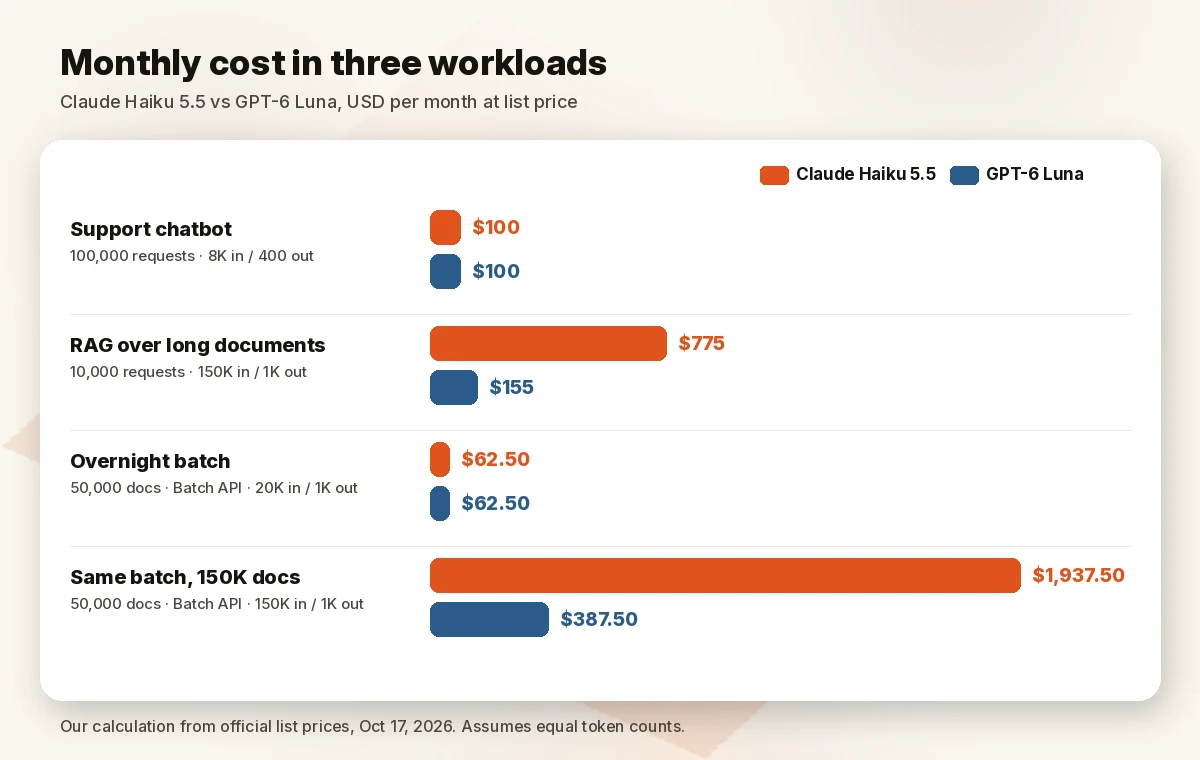
Assumptions: 100,000 requests a month; each sends 8,000 input tokens (system prompt, help-center snippets, recent turns) and gets 400 output tokens back.
- Claude Haiku 5.5: 800M input tokens × $0.10 = $80, plus 40M output tokens × $0.50 = $20. Total: $100 a month.
- GPT-6 Luna: 800M × $0.10 = $80, plus 40M × $0.50 = $20. Total: $100 a month.
- With prompt caching: say 6,000 of the 8,000 tokens are a stable prefix that hits the cache. Per month that’s 200M uncached × $0.10 = $20, plus 600M cached × $0.01 = $6, plus $20 output. About $46 on either model, before cache-write charges, which are $0.125 per million on both for Haiku’s 5-minute cache and Luna’s cache writes.
- If reasoning adds 300 output tokens per request: 30M × $0.50 = $15 more a month, on either model.
What it means: at this prompt size, price can’t decide for you. Quality on your actual tickets, latency, refusal behavior and which SDK your team already uses will matter more. One thing to watch: long support conversations grow. If your chatbot carries full history and some threads cross 100K tokens, those requests flip to Haiku’s higher tier.
Scenario 2: RAG over long documents, 150K prompts
Assumptions: 10,000 requests a month; each stuffs 150,000 tokens of retrieved contract or report text into the prompt and gets 1,000 output tokens back.
- Claude Haiku 5.5 (over-100K rates): 1,500M × $0.50 = $750, plus 10M × $2.50 = $25. Total: $775 a month.
- GPT-6 Luna (still short-context): 1,500M × $0.10 = $150, plus 10M × $0.50 = $5. Total: $155 a month.
- With 120K of each prompt cached: Haiku = 300M × $0.50 + 1,200M × $0.05 + $25 = $235. Luna = 300M × $0.10 + 1,200M × $0.01 + $5 = $47. Caching shrinks both bills but leaves the 5x ratio in place.
- Trim retrieval to 95K tokens: both models drop back to $0.10 / $0.50, and each costs 950M × $0.10 + 10M × $0.50 = $100 a month.
What it means: this is where the tie breaks. If your prompts genuinely need 100K to 272K tokens, Luna’s list price is a fifth of Haiku’s. Haiku only makes sense here if your own evals show its answers are worth the premium, or if you can cut retrieval under 100K, which for many RAG pipelines is a reranking problem, not a model problem.
Scenario 3: an overnight batch job
Assumptions: 50,000 documents a month through each vendor’s Batch API; each request has 20,000 input tokens and 1,000 output tokens.
- Claude Haiku 5.5 Batch (≤100K): 1,000M × $0.05 = $50, plus 50M × $0.25 = $12.50. Total: $62.50 a month.
- GPT-6 Luna Batch (≤272K): 1,000M × $0.05 = $50, plus 50M × $0.25 = $12.50. Total: $62.50 a month. Luna’s Flex tier is listed at the same rates.
- Same job with 150K-token documents: Haiku Batch = 7,500M × $0.25 + 50M × $1.25 = $1,937.50. Luna Batch = 7,500M × $0.05 + 50M × $0.25 = $387.50.
What it means: batch halves both price lists, so it doesn’t change which model wins. It only changes how much the gap costs you in dollars.
Lock-in and cloud platforms
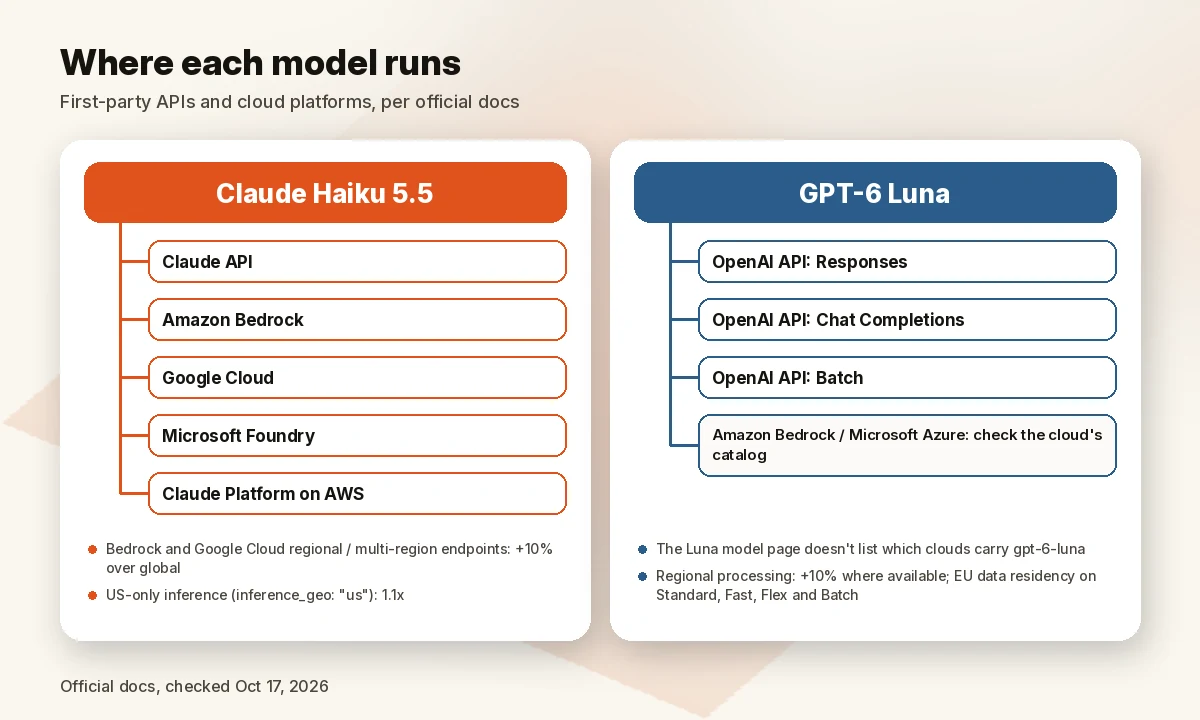
- Where Haiku 5.5 runs: Claude API, Amazon Bedrock, Google Cloud, Microsoft Foundry and Claude Platform on AWS (model overview). Bedrock and Google Cloud bill you directly, and Anthropic says their regional and multi-region endpoints carry a 10% premium over global endpoints. Claude Platform on AWS and Claude in Microsoft Foundry bill through the AWS and Azure marketplaces at standard Claude rates (Anthropic pricing).
- Where GPT-6 Luna runs: the OpenAI API (Responses, Chat Completions and Batch endpoints are listed as supported on the Luna page). OpenAI’s pricing page says OpenAI models on Amazon Bedrock and Microsoft Azure are billed through those services, but the Luna model page doesn’t list which clouds carry
gpt-6-luna, so check your cloud’s own catalog. - Switching cost: the two APIs differ in parameters, tool calling and reasoning controls (see the specs section). If you might move between them, keep prompts, tool schemas and evals in your own layer rather than inside one SDK’s conventions.
Our opinion: if you’re cost-sensitive and prompt sizes vary, routing by prompt length is the obvious pattern. Send short requests to whichever model wins your evals, and send 100K-plus requests to Luna unless Haiku’s quality on that workload clearly earns its 5x premium.
When to skip both
- Complex agentic coding. Anthropic itself says Sonnet 5.5 and Opus 5.5 “remain better choices for complex agentic coding tasks” (Haiku 5.5 launch), and its table shows Luna at 16.4% on Terminal-Bench 4.0. In our opinion, a bigger model can cost less per finished task than repeated retries on a small one; that’s a judgment, not a measured result.
- You need sampling controls on Haiku. Anthropic says to omit
temperature,top_pandtop_k; some values return a 400 error. - You can’t control output length. On Haiku’s over-100K tier, output is $2.50 per million, five times Luna’s $0.50 in the same band.
Who should pick which
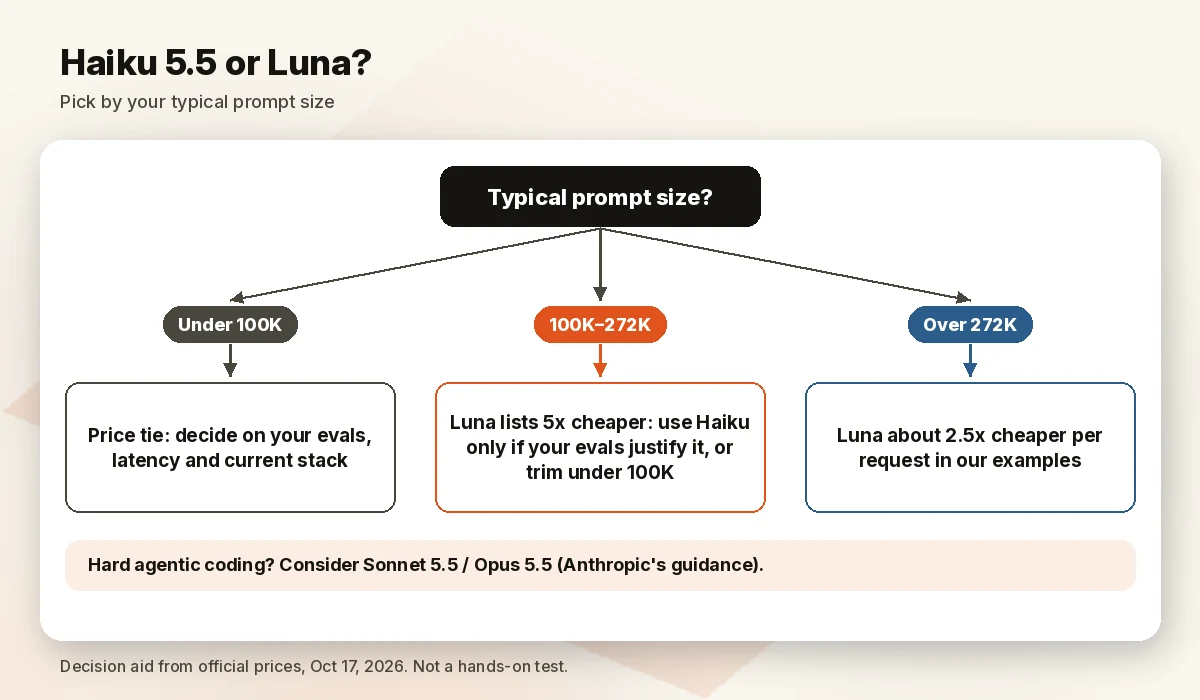
Pick Claude Haiku 5.5 if: most of your prompts stay under 100K tokens, you already build on Claude, Bedrock, Google Cloud or Foundry, you use Haiku as a fast subagent under Sonnet or Opus, or your own evals confirm the lead Anthropic reports.
Pick GPT-6 Luna if: many prompts land between 100K and 272K tokens, you want OpenAI’s Flex tier or EU data residency on Luna, or your stack already runs on the OpenAI Responses API.
Run both if: your traffic mixes short chats and long documents. At equal token counts, the short half costs the same on either, and the long half costs about a fifth as much on Luna between 100K and 272K tokens, and roughly 40% as much above 272K (API list prices).
Limitations
- API only. This compares API access and API list prices only. Availability and limits inside the Claude and ChatGPT apps are separate; see our GPT-6 in ChatGPT explainer.
- No hands-on testing. We haven’t run either model; this is a pricing and documentation comparison.
- All benchmark numbers come from Anthropic, which makes one of the two products.
- Our scenarios assume equal token counts on both models. Tokenizers differ, and Anthropic’s newer tokenizer counts about 30% more tokens than earlier Claude models for the same text.
- Base numbers exclude reasoning tokens, cache-write charges, tool-use overhead and regional multipliers.
- OpenAI writes the Luna threshold as “272K”; it doesn’t spell out the exact token count on the pages we checked.
- Prices change. Recheck both official pricing pages before you budget.
FAQ
Is Claude Haiku 5.5 cheaper than GPT-6 Luna? Not on short prompts: up to 100,000 prompt tokens both list $0.10 per million input tokens, $0.01 cached and $0.50 output. Above 100K, Haiku 5.5 rises to $0.50 / $2.50 while Luna stays at $0.10 / $0.50 until 272K, so Luna is cheaper for long prompts.
What is GPT-6 Luna’s context window? OpenAI’s model page lists a 1,050,000-token context window, a 922,000-token input maximum and 128,000 max output tokens.
Does GPT-6 Luna have a long-context price? Yes. Prompts with more than 272K input tokens are priced at 2x input and cache rates and 1.5x output for the full request: $0.20 input, $0.02 cached input, $0.25 cache writes and $0.75 output per million tokens.
Which is better on benchmarks? Anthropic reports Haiku 5.5 ahead of GPT-6 Luna on every benchmark where it published both, from GDPval-AA to Terminal-Bench 4.0. No independent results are cited here.
Haiku 5.5 vs Sonnet 5.5: which should I use? Sonnet 5.5 costs $2 / $10 per million input / output tokens with no prompt-length tier, and Anthropic says it remains the better choice for complex agentic coding. Haiku 5.5 is for high-volume, narrowly scoped work. Our Haiku 5.5 review covers the trade-off.
How does Haiku 5.5 compare with GPT-6.1 Sol on price? OpenAI lists gpt-6.1-sol at $2.00 input, $0.10 cached and $10.00 output per million tokens for short context, and $4.00 / $0.20 / $15.00 above 272K. That’s 20x Haiku’s and Luna’s short-prompt input and output rates. We don’t compare their benchmarks, because no single source tests both on one method. Our GPT-6 in ChatGPT guide covers where Sol shows up.
What is the cheapest LLM API in 2026? There isn’t a single answer. Between these two, it’s a tie on short prompts and Luna on long ones. OpenAI’s own price list also includes older models with a lower input price, such as gpt-5-nano at $0.05 input / $0.40 output, and Haiku 5.5’s Batch rate is $0.05 / $0.25. Cheapest per token isn’t cheapest per finished task if a model needs retries.
How we compared
We built this from official pages only, checked on October 17, 2026 (America/Sao_Paulo): Anthropic’s API pricing page, the Haiku 5.5 model overview and launch post, OpenAI’s API pricing page, the GPT-6 Luna model page and the GPT-6.1 Sol post, plus each vendor’s documentation on how reasoning tokens are billed. Cost scenarios are our arithmetic on those list prices, with the token assumptions stated in each scenario. We make no claims about output quality or speed beyond what the vendors report.
Sources (official pages, checked on October 17, 2026 ~01:05–01:15 BRT)
- Anthropic, Claude API pricing (Haiku 5.5 tiers, batch, caching, long-context rule, data residency, tokenizer note): platform.claude.com/docs/en/about-claude/pricing (HTTP 200)
- Anthropic, Claude Haiku 5.5 model overview (model IDs, context, max output, effort, cutoff, platforms, sampling parameters): platform.claude.com/docs/en/models/haiku-5-5/overview (HTTP 200)
- Anthropic, Introducing Claude Haiku 5.5 (Oct 7, 2026; benchmark table incl. GPT-6 Luna column): anthropic.com/claude-haiku-5-5 (HTTP 200)
- Anthropic, thinking documentation (thinking billed as output): platform.claude.com/docs/en/build-with-claude/thinking (HTTP 200)
- OpenAI, GPT-6 Luna model page (context window, max input, max output, cutoff, >272K rule, endpoints): platform.openai.com/docs/models/gpt-6-luna (HTTP 200)
- OpenAI, API pricing (Standard, Batch, Flex, Fast tables; short/long context definition; regional uplift; cloud billing note; gpt-6.1-sol and gpt-5-nano rows): platform.openai.com/docs/pricing (HTTP 200)
- OpenAI, reasoning guide (reasoning tokens billed as output): platform.openai.com/docs/guides/reasoning (HTTP 200)
- OpenAI, Introducing GPT-6.1 Sol (Sep 29, 2026; Luna headline prices): openai.com/index/introducing-gpt-6-1-sol (WebFetch OK; curl 403 from our server)
Tools we use alongside (outside this comparison, not a ranking of Claude or GPT models)
If you’re turning a model choice into a product, Base44 is an AI app builder for prototyping apps without building the whole stack yourself. If you publish content around AI launches, Semrush covers keyword and competitor research (we compared it with Surfer in Surfer SEO vs Semrush). Base44 and Semrush links are sponsored; Anthropic and OpenAI links above are not.