
Affiliate disclosure: AI Tools Vetted is reader-supported. Anthropic has no affiliate program with us, so every Anthropic / Claude link here is a plain outbound link (
rel="nofollow noopener") and earns us nothing. Sponsored affiliate/go/links for Semrush and Grammarly appear only in the separate “Tools we use alongside” box at the end.
Prices, specs and benchmarks checked November 9, 2026 (evening, America/Sao_Paulo) on Anthropic’s launch post and Claude Platform docs (USD, before tax). This is a research-based review from official pages—not a hands-on test. We did not call the API or re-run Anthropic’s evals, so we do not claim “we tested” Claude Fable 5.2.
What launched (TL;DR)
Anthropic released Claude Fable 5.2 on November 9, 2026 as its generally available frontier model for demanding reasoning and long-horizon agentic work. Key facts from Anthropic the same day:
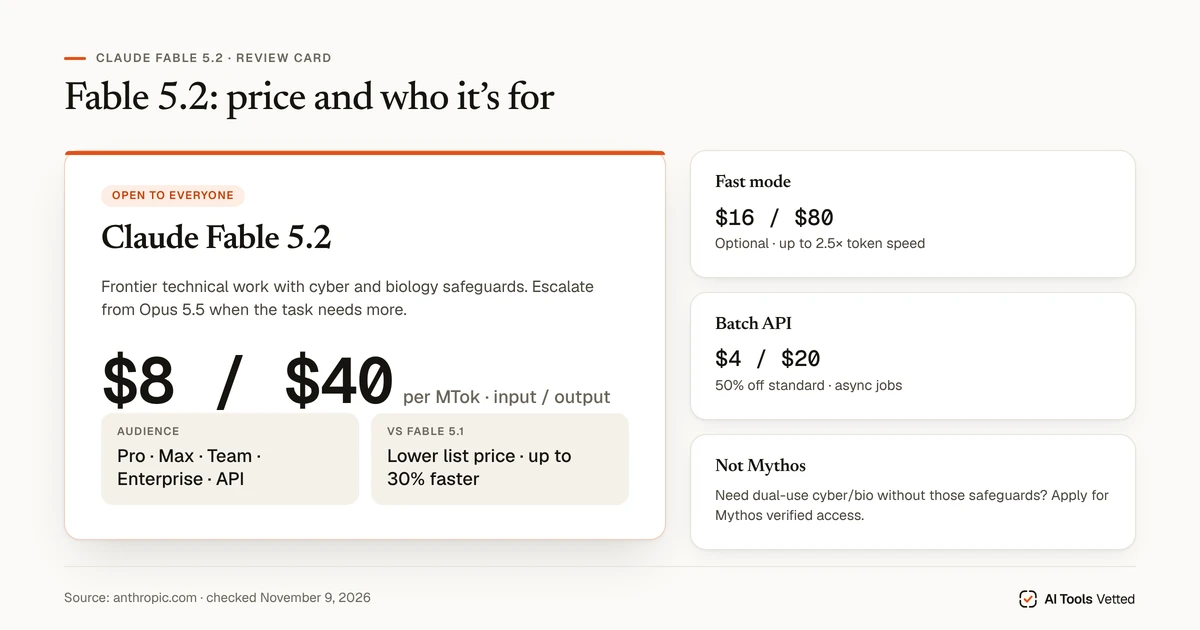
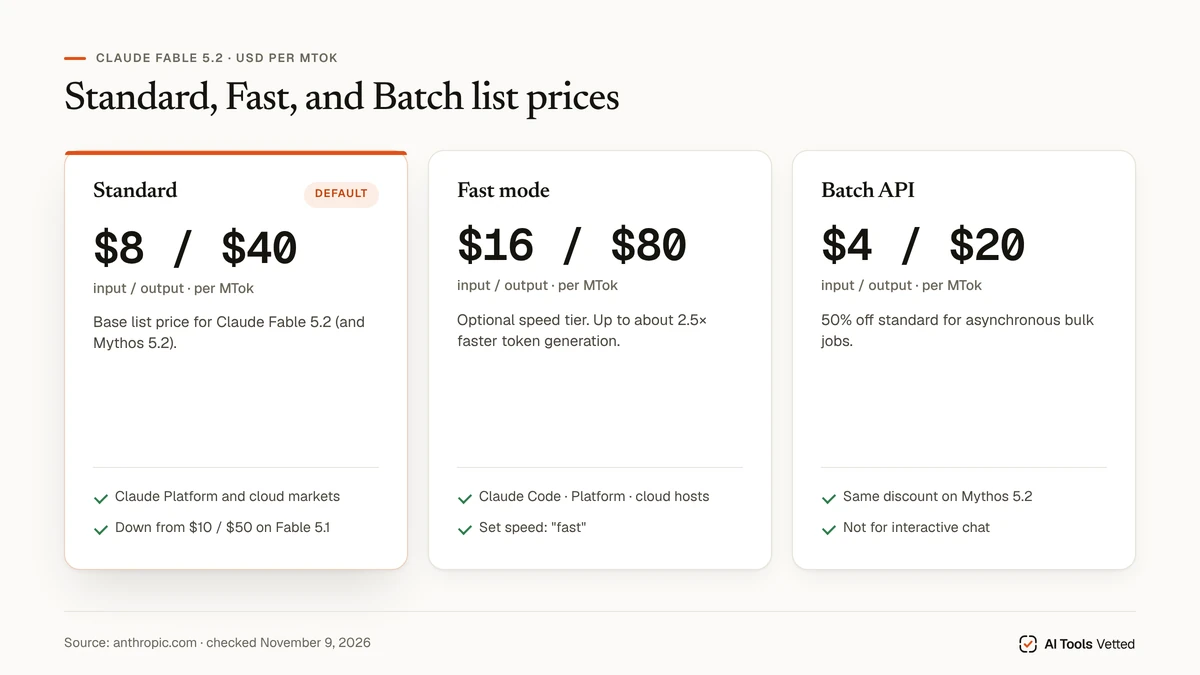
- API list price: $8 per million input tokens / $40 per million output tokens (down from Fable 5.1’s $10 / $50 on the same pricing docs).
- Fast mode: up to 2.5× generation speed at $16 / $80 per MTok.
- Speed claim: outputs up to 30% faster than Fable 5.1.
- Specs: model ID
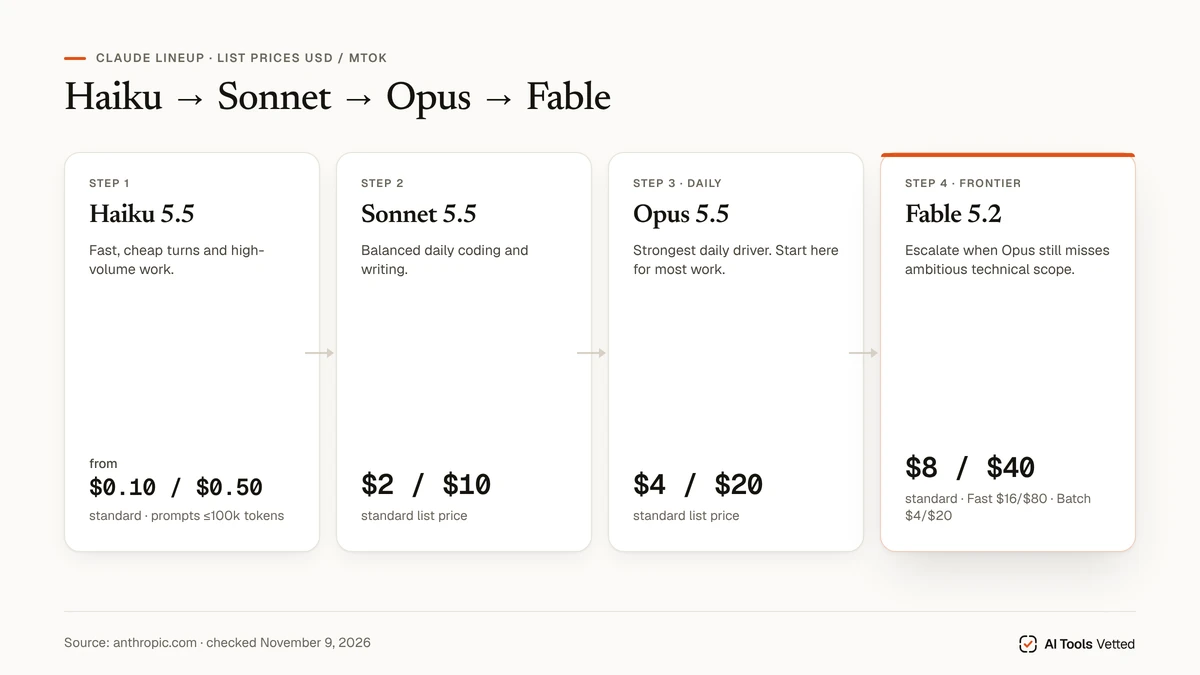
claude-fable-5-2; 1M context; 128K max output; adaptive thinking (always on); default efforthigh; knowledge cutoff June 2026. - Role in the lineup: Anthropic still recommends Claude Opus 5.5 ($4 / $20) as the daily driver; escalate to Fable when Opus evals miss.
- Twin model: Claude Mythos 5.2 is the same underlying model for verified organizations—see Claude Fable 5.2 vs Mythos 5.2.
Opinion: Fable 5.2 is worth budgeting when you already know Opus 5.5 is not enough for a long-running agentic or research workload—not as a default replacement for every Claude call.
Pricing (API + fast mode)
Official figures from Anthropic’s pricing surfaces on November 9, 2026:
| Rate (USD / MTok) | Fable 5.2 | Fable 5.1 | Opus 5.5 |
|---|---|---|---|
| Input | $8 | $10 | $4 |
| Output | $40 | $50 | $20 |
| 5-minute cache write | $10 | $12.50 | $5 |
| 1-hour cache write | $16 | $20 | $8 |
| Cache read | $0.20 | $0.25 | $0.20 |
| Fast mode in/out | $16 / $80 | — | $8 / $40 |
| Batch in/out | $4 / $20 | $5 / $25 | $2 / $10 |
Sources: platform.claude.com/docs/…/pricing and anthropic.com/pricing, checked November 9, 2026.
That is a 20% cut on base input/output versus Fable 5.1 ($10→$8 and $50→$40). Batch halves standard rates. Prompt-cache reads on Fable 5.2 are priced at 0.025× base input ($0.20).
Claude.ai / Team seat access to Fable (not the API MTok table above) — two different rules, two sources, checked November 9, 2026:
- Permanent plan rule on anthropic.com/pricing: Pro accesses Fable paid with usage credits. Max and Ultra include Fable for up to half / 50% of the weekly usage limit. On Team, Fable is included on premium seats up to 50% of each member’s weekly usage limit; standard seats can use Fable with usage credits enabled.
- Launch-week promotion only (Anthropic launch post, week of November 9, 2026): “This week” Anthropic is giving eligible paid-plan subscribers extra Fable usage—one to three Fable resets based on how long they’ve subscribed, and Fable included for up to 50% of weekly usage limits for Pro plans and standard seats on the Team plan. That Pro / Team-standard 50% framing is the Fable 5.2 launch promotion, not the standing Pro card on the pricing page (which still says Pro uses Fable via usage credits). Confirm whether the promo is still active before you budget seat usage.
Specs Anthropic publishes
| Spec | Claude Fable 5.2 (official) |
|---|---|
| Model ID (Claude API) | claude-fable-5-2 |
| Context window | 1M tokens |
| Max output | 128K tokens |
| Input → output | Text and images → text |
| Thinking | Adaptive (always on) |
| Default effort | high |
| Knowledge cutoff | June 2026 |
| Status | Active (latest); released November 9, 2026 |
| Platforms (launch + docs) | Claude Platform / API; Amazon Bedrock; Google Cloud; Microsoft Foundry; Claude Platform on AWS |
Source: Fable 5.2 model overview, November 9, 2026.
The overview also notes Fable 5.2 requires 30-day data retention and is not available under zero data retention unless expressly authorized—check that against your enterprise contract. The “what’s new” page lists breaking changes versus Fable 5.1 (prefix check on every account; thinking-block compatibility; computer-use tool versioning; advisor-tool pairing). Read that page before you migrate production harnesses.
Benchmarks: what Anthropic reports
These scores come from Anthropic’s November 9, 2026 launch table. They are Anthropic’s evaluations, not independent labs and not AI Tools Vetted runs. We cite the launch table and did not reproduce the System Card. Full methodology and safety detail: Claude Fable 5.2 and Mythos 5.2 System Card (HTTP 200, checked November 9, 2026).
Table notes (from Anthropic’s launch page): scores for Fable 5.2, Fable 5.1 and Opus 5.5 show results with safeguards on unless otherwise noted; all scores show each model’s highest-available effort unless otherwise noted. This is a selected subset of Anthropic’s rows—we omit WANDR, CyScenarioBench, CVE Rediscovery and protein-design lines here (several of those are Mythos-reported or “without safeguards” columns on the same page).
| Benchmark (Anthropic labels) | Fable 5.2 | Fable 5.1 | Opus 5.5 |
|---|---|---|---|
| FrontierCode 2.0 (agentic coding) | 49.1% Xhigh effort | 32.4% Xhigh | 45.5% |
| FrontierSWE v2 | 69.9% | 56.3% | 62.3% |
| AutomationBench | 51.4% | 31.4% | 42.5% |
| Terminal-Bench-Science 0.1 | 74.6% | 52.6% | 58.7% |
| OSWorld 2.1 (offline, partial) | 89.3% | 83.5% | 87.2% |
| RoboDojo Sim | 64.9% | 27.6% | 39.4% |
| AA-Briefcase v1.1 | 66.1% rubric / 1785 Elo | 61.5% / 1669 Elo | 61.2% / 1800 Elo |
| Remote Labor Index (High effort) | 41.3% | 17.9% | 21.3% |
| Humanity’s Last Exam (with tools) | 74.2% | 65.6% | 67.7% |
| Chartography (no tools) | 73.4% | 44.8% | 64.4% |
Anthropic also publishes cost-vs-accuracy charts claiming, for example, that at High effort Fable 5.2 scores about level with Opus 5.5’s best FrontierCode score for roughly half the cost per task, and that at Low effort on Humanity’s Last Exam it matches Opus 5.5’s top score for less than one-tenth the cost per task. Those efficiency claims are Anthropic’s; verify on your workload.
Opinion: Use the table to understand how Anthropic positions Fable inside its own lineup. Do not treat competitor columns on the launch page (GPT-6 Astra, Gemini 4 Carbon) as settled cross-lab truth without reading the System Card footnotes.
Who it’s for / who should skip
Start with Opus 5.5, escalate when…
Anthropic’s launch and “what’s new” docs agree: for most coding and knowledge work, start with Claude Opus 5.5. Move to Fable 5.2 when higher-effort Opus evals still miss your requirements—especially long-horizon agents, stubborn migrations, ambiguous research systems, or hardware/science-adjacent software work Anthropic showcases (always as vendor-attributed examples, not our results).
Good fit (opinion grounded in Anthropic’s framing): platform/infra teams running multi-hour agent loops; research groups coordinating code + documents; builders who already measure Opus failure modes.
Skip or defer: high-volume classification/summarization (see Claude Haiku 5.5); routine coding where Opus or Sonnet is enough; teams whose bottleneck is SEO tooling or marketing drafts rather than model IQ (best AI content writer, Semrush review).
Fable vs Mythos in one paragraph
Fable 5.2 and Mythos 5.2 are the same underlying model at the same API price. Fable ships with cyber/biology safeguards for general availability; Mythos is gated to verified organizations that need those dual-use capabilities. Full decision tree: Claude Fable 5.2 vs Mythos 5.2.
What this changes for you
Agentic coding (per Anthropic): launch examples include large migrations and multi-agent projects. Anthropic reports FrontierCode 2.0 at 49.1% Xhigh for Fable 5.2 versus 45.5% for Opus 5.5 and 32.4% for Fable 5.1. We did not reproduce those merges.
Research / analysis (per Anthropic): early-tester quotes on the launch page claim better judgment on ambiguous, data-heavy tasks. Treat quotes as vendor testimonials.
Science, math, hardware, robotics (per Anthropic): the launch post attributes open physics calculations, Fermat formalization timing, three working electronic devices and RoboDojo gains to Fable/Mythos 5.2. Extraordinary claims stay attributed—“per Anthropic”—and sit outside anything we verified beyond reading the page.
Cost lever: if you already burn Opus Max-effort tokens on hard tasks, Anthropic’s own cost-vs-accuracy charts argue Fable can match or beat Opus scores at lower spend on some evals. Re-run that math on your traces before you switch the default model ID.
Fast mode availability (Nov 9, 2026): Anthropic’s launch post lists fast mode for Claude Fable 5.2 on Claude Code, the Claude Platform, Claude Models on Google Cloud (Anthropic managed and Google managed), and Microsoft Foundry (Anthropic hosted). Confirm the meter on the host you actually call.
Where Haiku still wins on price: Claude Haiku 5.5 remains the high-volume rung at $0.10 / $0.50 per MTok for prompts up to 100,000 tokens on Anthropic’s pricing docs (higher rates above that line).
Limitations
- Safeguards: Fable blocks high-risk cyber work and most research-biology tasks; when a query is blocked, Anthropic’s launch post says users receive a response from Opus 4.8 for cybersecurity and Opus 5 for biology. If you need the open dual-use surface, you want Mythos via verification—not a Fable prompt trick.
- Mythos is gated: same IQ story, different access paperwork.
- Retention: docs note 30-day retention / limited ZDR for Fable 5.2.
- Migration friction: “what’s new” lists breaking changes versus 5.1.
- No first-party test here: latency, refusal rates and code quality on your stack are unknown to us as of this writing.
- System Card: read the Fable 5.2 / Mythos 5.2 System Card before enterprise rollout—we cite the launch table, not the full card text.
Tools we use alongside
Outside this Claude review. For keyword and competitor research around AI launches, Semrush (see Semrush review). For in-workflow editing of the drafts you publish, Grammarly (see Grammarly review). Sponsored links; Anthropic links above are not.
How we evaluated
We read the Anthropic announcement and Claude Platform Fable 5.2 / Mythos 5.2 / pricing / what’s-new pages on November 9, 2026, saved raw HTML under fila/artigos/raw-A66-20261109/, and used The Verge and CNBC only as secondary confirmation of the launch date—not as sources for prices or benchmarks. No API latency or quality test claimed.
FAQ
How much does Claude Fable 5.2 cost?
As of November 9, 2026: $8 / MTok input, $40 / MTok output, fast mode $16 / $80, batch $4 / $20, cache read $0.20.
Is Claude Fable 5.2 better than Opus 5.5?
Anthropic’s launch table shows Fable ahead of Opus 5.5 on several of its own benchmarks (for example FrontierCode 2.0 at Xhigh: 49.1% vs 45.5%). It is not a clean sweep: on AA-Briefcase v1.1, Opus 5.5 leads the Elo column (1800 vs Fable 5.2’s 1785), even though Fable’s rubric % is higher (66.1% vs 61.2%)—same Anthropic launch table, November 9, 2026. Anthropic still calls Opus 5.5 the strongest daily driver. “Better” depends on the job. Opinion: Opus first; Fable when evals demand it.
What is Claude Fable 5.2 fast mode?
Optional faster generation (up to 2.5× per Anthropic) at 2× standard MTok rates ($16 / $80), available on listed platforms in the pricing docs.
Is Claude Fable 5.2 available to everyone?
Yes on the Claude API / listed clouds for Fable. Mythos 5.2 is the verification-gated twin—details in Fable vs Mythos.
Claude Fable 5.2 vs Mythos 5.2 — what’s the difference?
Same underlying model and price; different safeguards and access. Full comparison: Claude Fable 5.2 vs Mythos 5.2.
Sources
Official pages checked November 9, 2026 (America/Sao_Paulo):
- Anthropic launch: Fable 5.2 & Mythos 5.2 (pricing claims, benchmarks table, availability)
- Claude Fable 5.2 and Mythos 5.2 System Card
- Fable 5.2 model overview
- What’s new in Fable 5.2
- Mythos 5.2 model overview
- Claude Platform pricing · anthropic.com/pricing
- Press context: The Verge · CNBC
- Internal: Fable vs Mythos · Claude Haiku 5.5 · Haiku 5.5 vs GPT-6 Luna · Gemini 4 Argon · GPT-6 in ChatGPT · Semrush review · Grammarly review · best AI content writer